How To Find And Hire Expert Java Developers?
Finding and hiring expert Java developers requires more than checking technical skills. Businesses need to consider relevant experience, project requirements, hiring models, costs, and communication. A clear hiring process helps companies find Java developers who fit their technical needs and can work effectively with their teams.
In this blog, we'll cover the essential skills to look for, hiring models, developer costs, and common mistakes to avoid when choosing the right Java developer for your project.

“Furqan Aziz is CEO & Founder of InvoZone. He is a tech enthusiast by heart with 10+ years ...” See more
Don’t Have Time To Read Now? Download It For Later.
Table of Contents
- What Makes A Good Java Developer?
- Where To Find Java Developers
- How To Hire Java Developers: Step-by-Step
- Step 1. Define Your Project Requirements
- Step 2. Choose A Hiring Model
- Step 3. Create A Clear Job Description
- Step 4. Review Relevant Experience
- Step 5. Conduct A Technical Interview
- Step 6. Test Their Problem Solving Skills
- Step 7. Check Communication And Availability
- Step 8. Make The Offer And Onboard Them
- How Much Does It Cost To Hire A Java Developer?
- Remote Developer Price by Region
- Freelance Vs. Dedicated Java Developers: Which Fits Your Project?
- Red Flags To Watch For When Hiring Java Developers
- Common Mistakes When Hiring Java Developers
- Choose The Right Java Developer For Your Project
- Questions To Ask Before Hiring A Java Developer
- Build Your Java Development Team With InvoZone
- Making the Right Java Developer Hiring Decision
Hiring a Java developer may seem easy with so many profiles available online. But years of experience or a lower hourly rate don't always mean someone is the right fit for your project.
A good developer needs more than technical skills.
They should understand your tech stack, project requirements, and team environment.
That's why knowing how to hire an expert Java developer matters more than simply choosing the most experienced or affordable candidate.
What Makes A Good Java Developer?
Before you start searching, it helps to know what you are actually looking for. A good Java developer needs more than basic knowledge of the language.
The right developer should have a combination of technical skills, relevant project experience, and the ability to work well with your team.
Technical Skills
Depending on your project, look for experience with:
- Core Java
- Spring and Spring Boot
- REST APIs
- SQL and databases
- Microservices
- Git
- Cloud platforms
- Testing and debugging
You do not necessarily need every skill on this list. The important thing is to match the developer’s experience with your actual technology stack.
Problem Solving Skills
Java development involves more than writing code. Developers need to troubleshoot bugs, improve performance, understand requirements, and deal with unexpected technical issues.
Ask candidates how they would approach real problems instead of only asking them to explain technical definitions.
Communication Skills
A developer may work closely with your product managers, designers, QA team, and other developers.
Clear communication makes that collaboration easier, especially when the team works remotely.
Where To Find Java Developers
Once you know what skills you need, the next step is finding suitable candidates.
|
Where to Look |
Best for |
Where to consider |
|
Freelance Platforms |
Short-term tasks and specific features |
You need to handle screening, communication, and project management. |
|
Job Platforms |
Full-time or long-term hiring |
You need to handle screening, communication, and project management. |
|
Developer Communities |
Finding developers with specific technical interests |
You may need to spend more time checking experience and project fit. |
|
Software Development Companies |
Building or expanding a development team |
You can share your requirements and find developers based on skills and project experience. |
How To Hire Java Developers: Step-by-Step
Java remains a widely used technology, and demand for developers with Java and AI skills has been growing.

Step 1. Define Your Project Requirements
Start by identifying what you need the developer to do.
Consider:
- What are you building?
- Which Java technologies are required?
- Do you need Spring Boot?
- Will the developer work with APIs or databases?
- Do you need cloud or microservices experience?
- How long will the project run?
- Will they work independently or with an existing team?
Clear requirements make it easier to find relevant candidates.
Step 2. Choose A Hiring Model
Decide whether you need a full-time developer, freelancer, dedicated developer, or staff augmentation. For a small task, a freelancer may be enough, while a dedicated developer may be a better choice for long-term product development. The benefits of a dedicated team model include continuity, deeper product knowledge, and easier scaling.
If you need to quickly expand an existing team, staff augmentation can provide additional development capacity without requiring a permanent hire.
Step 3. Create A Clear Job Description
Do not focus only on the number of years someone has worked with Java. Look at the type of projects they have worked on, the technologies they have used, and whether their experience matches your requirements. For example, a developer with experience building Spring Boot APIs may be more relevant to a backend project than someone with more years of general Java experience.
Step 4. Review Relevant Experience
Do not focus only on the number of years someone has worked with Java. Look at the type of projects they have worked on, the technologies they have used, and whether their experience matches your requirements.
For example, a developer with experience building Spring Boot APIs may be more relevant to a backend project than someone with more years of general Java experience. It also helps to understand how companies vet remote developers before making an offer.
Step 5. Conduct A Technical Interview
Use the interview to understand how the developer thinks and applies their knowledge.
You can discuss:
- Core Java
- Object-oriented programming
- Spring Boot
- REST APIs
- Databases
- Microservices
- Performance
- Security
Practical questions are often more useful than asking candidates to memorize definitions. Following a structured remote developer interview process can help assess technical skills, problem-solving abilities, and potential hiring red flags.
Step 6. Test Their Problem Solving Skills
Give the candidate a realistic problem related to your project. For example, ask how they would troubleshoot a slow API or handle increasing traffic in a Java application. You want to understand their approach, not just whether they know the correct technical term.
Step 7. Check Communication And Availability
Make sure the developer can communicate clearly and is available during the hours your team needs. Strong time zone alignment makes daily collaboration and quick fixes much easier. If the project is long-term, also discuss how long they can commit to the work.
Step 8. Make The Offer And Onboard Them
Once you select a developer, clearly explain the responsibilities, working arrangement, compensation, and project expectations. Good onboarding also matters. Give the developer access to the documentation, codebase, tools, and people they need to get started.
How Much Does It Cost To Hire A Java Developer?
The cost of hiring a developer depends on several factors.
These include:
- Experience level
- Location
- Project complexity
- Technical skills
- Hiring model
- Project duration
- Full-time or part-time engagement
An experienced developer working on a complex enterprise application will usually have different requirements from someone handling a small backend task. This is why comparing developers only by their hourly rate can be misleading.
Remote Developer Price by Region
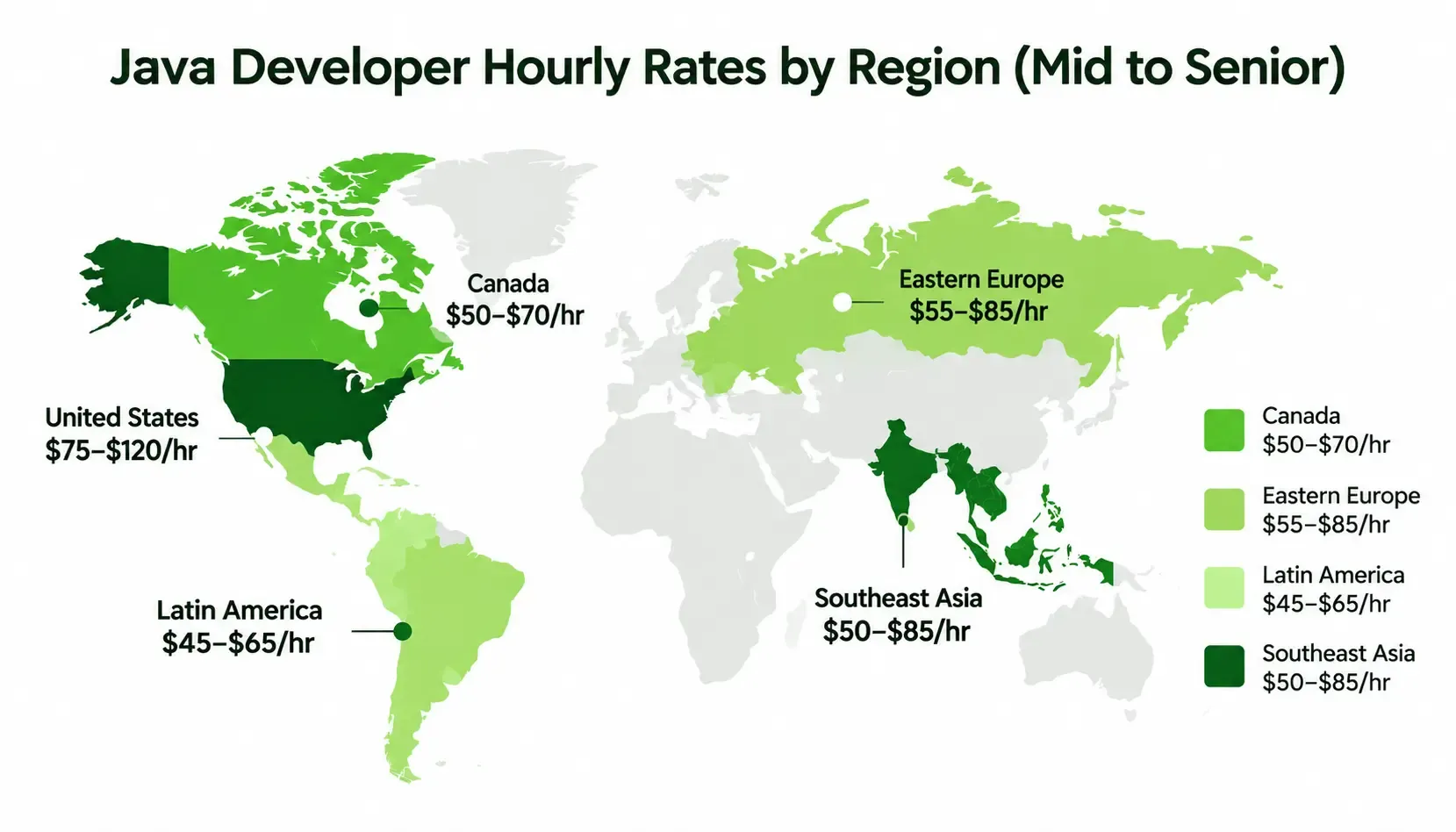
This table breaks down hourly rates by region, from junior to senior level. For more on each market, see the best countries to hire remote developers.
|
Region |
Junior to Mid-Level |
Mid-Level to Senior |
|
United States |
$30 – $75 / hr |
$75 – $120 / hr |
|
Canada |
$28 – $50 / hr |
$50 – $70 / hr |
|
Eastern Europe |
$25 – $55 / hr |
$55 – $85 / hr |
|
Latin America |
$22 – $45 / hr |
$45 – $65 / hr |
|
Southeast Asia |
$20 – $50 / hr |
$50 – $85 / hr |
Expert Advice: A Low Hourly Rate Can Hide Long-Term Costs
A lower hourly rate doesn't always mean a lower overall project cost. Time spent screening candidates, managing tasks, fixing issues, or replacing a developer can increase expenses.
When comparing rates, remember why the cheapest developer often costs more in the long run. A freelancer may be suitable for a small, clearly defined task, while dedicated developers can offer greater continuity for long-term projects.
The right hiring model depends on your project's scope, duration, budget, and level of technical support required.
Freelance Vs. Dedicated Java Developers: Which Fits Your Project?
The right option depends on the work you need to complete. This comparison of remote developers vs. freelancers covers the trade-offs in more detail.
|
Your Situation |
More Suitable Option |
|
Small Bug Fix |
Freelancer |
|
One time API Integration |
Freelancer |
|
Short-term Feature |
Freelancer |
|
Simple Prototype |
Freelancer |
|
MVP Development |
Dedicated Developer |
|
SaaS Development |
Dedicated Developer |
|
Enterprise Application |
Dedicated Developer |
|
Long term Maintenance |
Dedicated Developer |
|
Scaling an Engineering Team |
Dedicated Developer |
|
Specialized Java Expertise |
Dedicated Developer |

Red Flags To Watch For When Hiring Java Developers
Not every developer who looks good on paper will be a good fit. Use this table to spot warning signs during screening and interviews.
|
Red Flag |
What It Looks Like |
Why It Matters |
|
Vague answers about past work |
Cannot describe a specific project, tech stack, or problem they solved |
Good developers can talk about their work in detail |
|
Cannot explain technical decisions |
Cannot say why they chose Spring Boot over plain Java or microservices over a monolith |
They likely did not make those decisions themselves |
|
No portfolio or code samples |
Empty GitHub, only tutorial projects, or no live work to inspect |
No proof of real-world experience |
|
Dismissive about testing |
Says testing slows them down or documentation is unnecessary |
Often leads to bugs, rework, and maintenance problems |
|
Rate far below market |
Charges much less than average for their region and skill level |
May lack experience, cut corners, or leave early |
|
Poor communication during scheduling |
Takes days to reply before hiring |
Will likely be worse after hiring |
|
Frequent job changes with no explanation |
Leaves every few months without a clear reason |
May indicate fit or commitment issues |
|
No experience with your project type |
Strong Java skills but no work in your stack, industry, or scale |
Relevant experience matters more than total years |
Treat these warning signs as reasons to investigate further rather than automatic deal-breakers. Evaluate candidates based on verified experience, technical assessments, communication, and project fit before making a decision.
Common Mistakes When Hiring Java Developers
Hiring the wrong developer can lead to delays, rework, and additional costs.
Hiring Based On Cost
The lowest rate should not be the reason for choosing a developer. Consider their experience, project fit, communication, and quality of work as well.
Years Of Experience
More years of experience do not automatically mean a better fit. Relevant experience with your technology stack and project type matters more.
Skipping Technical Assessment
A CV tells you what a developer claims to know. A technical interview or practical assessment helps you understand how they actually apply those skills.
Communication Gap
Poor communication can slow down development. Make sure the developer can explain technical issues clearly and work with the rest of your team.
Not Planning For Continuity
What happens if the developer becomes unavailable? Documentation, knowledge transfer, and a suitable hiring model can help reduce this risk.
Choose The Right Java Developer For Your Project
Not all Java devs do the same thing ,here is a simple breakdown to help you pick the right fit.
|
Project Type |
Java Skills to Look For |
|
Backend Development |
Core Java, Spring Boot, REST APIs, SQL |
|
Microservices |
Spring Boot, REST APIs, Docker, Cloud |
|
Enterprise Applications |
Java, Spring, Databases, Security |
|
Cloud Development |
Java, Spring Boot, AWS/Azure, APIs |
|
SaaS Development |
Java, Spring Boot, Microservices, Cloud |
|
API Development |
Java, Spring Boot, REST APIs, Database Integration |
Questions To Ask Before Hiring A Java Developer
Before making your final decision, ask:
- Have they built and deployed a Spring Boot application in production?
- How do they design and version REST APIs?
- How have they solved a real database performance problem in Java?
- Have they worked with microservices, and how did services communicate?
- How do they write and run tests (JUnit, Mockito, integration tests)?
- Which Java version do they use most, and what features do they rely on?
- How do they debug a slow API in production?
- Which cloud platforms and services have they used?
- Can they share a project similar to ours, with their exact role?
- What hours can they work, and how do they handle time zones?
The answers can help you look beyond a CV and make a more informed hiring decision.
Build Your Java Development Team With InvoZone
Building a Java development team from scratch can take weeks of searching, screening, and onboarding. InvoZone makes this easier by connecting businesses with 1,000+ pre-vetted remote developers across different technologies and skill sets, with an average matching time of 24 hours.
With flexible team options, 5 global resource centers, and over 12 years of experience, InvoZone helps businesses find developers who match their project needs. Whether you're working on backend systems, APIs, enterprise applications, cloud solutions, or ongoing product development, you can build a team based on your specific requirements.
Making the Right Java Developer Hiring Decision
Hiring an expert Java developer starts with understanding your project's technical requirements, budget, and long-term goals. Look beyond experience and hourly rates to evaluate problem-solving skills, communication, and relevant project expertise.
The right hiring model also matters. Freelancers may be suitable for smaller tasks, while dedicated developers or staff augmentation can provide greater continuity for complex projects and ongoing development.
Ultimately, the best Java developer is someone who understands your technology stack, works effectively with your team, and can support your application's growth. Making the right choice helps reduce hiring risks, maintain code quality, and achieve better development outcomes.
Ready to find the right fit? Share your project requirements and we'll match you with the right developers.
Share to:
Frequently Asked Questions
Find answers to common questions about our services
1.How do I find an expert Java developer?
You can find Java developers through freelance platforms, job boards, developer communities, recruitment providers, and software development companies. InvoZone connects you with pre-vetted remote Java developers matched to your project requirements, so you skip the sourcing and screening overhead.
2.What skills should I look for in a Java developer?
Look for strong Core Java knowledge and relevant experience with Spring Boot, REST APIs, databases, microservices, Git, and cloud technologies. Problem-solving and communication skills matter just as much as technical knowledge.
3.What Java version and frameworks should I prioritize?
Prioritize a supported Java LTS version, such as Java 17, 21, or 25, depending on your project's requirements and framework compatibility. Java 25 is the latest LTS release. Spring Boot is a popular choice for backend and microservices development. Look for experience with Spring Data JPA, Spring Security, and Spring Cloud if your project uses the broader Spring ecosystem.
4.How much does it cost to hire a US-based Java developer?
Hiring a US-based Java developer typically costs $75-$120/hour for mid-level to senior roles. Rates vary by city, specialization, and project complexity. InvoZone offers Java developers at $30-$120/hour, 30–40% lower than traditional US hiring by connecting you with pre-vetted remote developers from our global resource centers. You get the same senior-level Java expertise and project fit, without the overhead of local hiring, recruitment fees, or long sourcing timelines.
5.How do I test Spring Boot skills specifically?
Ask about dependency injection, auto-configuration, and how they structure a Spring Boot application. Go deeper with questions on JPA relationships (One-to-Many, Many-to-Many), handling N+1 query problems, securing REST endpoints, and writing integration tests. Practical questions reveal real Spring Boot experience better than definitions.
6.What is the difference between a Java developer and a Spring Boot developer?
A Java developer focuses on the language itself Core Java, object-oriented programming, data structures, and general backend logic. A Spring Boot developer specializes in building applications using the Spring ecosystem, including REST APIs, dependency injection, security, and microservices. For modern backend projects, you usually need Spring Boot specialization.
7.Should I hire a Java developer hourly or fixed-price?
Use hourly when the scope may change ongoing development, debugging, or exploratory work. Use fixed-price when the deliverable is clearly defined upfront, such as a specific feature or API integration. InvoZone supports both models based on your project needs.
8.How can I evaluate a Java developer?
Use three signals: verifiable past work (GitHub, portfolio, live projects you can inspect), specific answers about technical trade-offs, and a practical problem-solving test based on your project. InvoZone pre-vets developers so you review only qualified candidates.
9.What is the difference between a freelance and dedicated Java developer?
A freelancer is hired for a specific task or project. A dedicated Java developer works closely with your existing team and stays involved in ongoing development for a longer period. InvoZone provides dedicated developers for long-term product work.
10.How quickly can I hire a Java developer?
The timeline depends on your requirements and developer availability. Sourcing from scratch can take weeks. InvoZone's pre-vetted talent pool and 24-hour matching reduce that to a few days, so you can start reviewing qualified Java developers almost immediately.
Table of Contents
- What Makes A Good Java Developer?
- Where To Find Java Developers
- How To Hire Java Developers: Step-by-Step
- Step 1. Define Your Project Requirements
- Step 2. Choose A Hiring Model
- Step 3. Create A Clear Job Description
- Step 4. Review Relevant Experience
- Step 5. Conduct A Technical Interview
- Step 6. Test Their Problem Solving Skills
- Step 7. Check Communication And Availability
- Step 8. Make The Offer And Onboard Them
- How Much Does It Cost To Hire A Java Developer?
- Remote Developer Price by Region
- Freelance Vs. Dedicated Java Developers: Which Fits Your Project?
- Red Flags To Watch For When Hiring Java Developers
- Common Mistakes When Hiring Java Developers
- Choose The Right Java Developer For Your Project
- Questions To Ask Before Hiring A Java Developer
- Build Your Java Development Team With InvoZone
- Making the Right Java Developer Hiring Decision
Hiring a Java developer may seem easy with so many profiles available online. But years of experience or a lower hourly rate don't always mean someone is the right fit for your project.
A good developer needs more than technical skills.
They should understand your tech stack, project requirements, and team environment.
That's why knowing how to hire an expert Java developer matters more than simply choosing the most experienced or affordable candidate.
What Makes A Good Java Developer?
Before you start searching, it helps to know what you are actually looking for. A good Java developer needs more than basic knowledge of the language.
The right developer should have a combination of technical skills, relevant project experience, and the ability to work well with your team.
Technical Skills
Depending on your project, look for experience with:
- Core Java
- Spring and Spring Boot
- REST APIs
- SQL and databases
- Microservices
- Git
- Cloud platforms
- Testing and debugging
You do not necessarily need every skill on this list. The important thing is to match the developer’s experience with your actual technology stack.
Problem Solving Skills
Java development involves more than writing code. Developers need to troubleshoot bugs, improve performance, understand requirements, and deal with unexpected technical issues.
Ask candidates how they would approach real problems instead of only asking them to explain technical definitions.
Communication Skills
A developer may work closely with your product managers, designers, QA team, and other developers.
Clear communication makes that collaboration easier, especially when the team works remotely.
Where To Find Java Developers
Once you know what skills you need, the next step is finding suitable candidates.
|
Where to Look |
Best for |
Where to consider |
|
Freelance Platforms |
Short-term tasks and specific features |
You need to handle screening, communication, and project management. |
|
Job Platforms |
Full-time or long-term hiring |
You need to handle screening, communication, and project management. |
|
Developer Communities |
Finding developers with specific technical interests |
You may need to spend more time checking experience and project fit. |
|
Software Development Companies |
Building or expanding a development team |
You can share your requirements and find developers based on skills and project experience. |
How To Hire Java Developers: Step-by-Step
Java remains a widely used technology, and demand for developers with Java and AI skills has been growing.

Step 1. Define Your Project Requirements
Start by identifying what you need the developer to do.
Consider:
- What are you building?
- Which Java technologies are required?
- Do you need Spring Boot?
- Will the developer work with APIs or databases?
- Do you need cloud or microservices experience?
- How long will the project run?
- Will they work independently or with an existing team?
Clear requirements make it easier to find relevant candidates.
Step 2. Choose A Hiring Model
Decide whether you need a full-time developer, freelancer, dedicated developer, or staff augmentation. For a small task, a freelancer may be enough, while a dedicated developer may be a better choice for long-term product development. The benefits of a dedicated team model include continuity, deeper product knowledge, and easier scaling.
If you need to quickly expand an existing team, staff augmentation can provide additional development capacity without requiring a permanent hire.
Step 3. Create A Clear Job Description
Do not focus only on the number of years someone has worked with Java. Look at the type of projects they have worked on, the technologies they have used, and whether their experience matches your requirements. For example, a developer with experience building Spring Boot APIs may be more relevant to a backend project than someone with more years of general Java experience.
Step 4. Review Relevant Experience
Do not focus only on the number of years someone has worked with Java. Look at the type of projects they have worked on, the technologies they have used, and whether their experience matches your requirements.
For example, a developer with experience building Spring Boot APIs may be more relevant to a backend project than someone with more years of general Java experience. It also helps to understand how companies vet remote developers before making an offer.
Step 5. Conduct A Technical Interview
Use the interview to understand how the developer thinks and applies their knowledge.
You can discuss:
- Core Java
- Object-oriented programming
- Spring Boot
- REST APIs
- Databases
- Microservices
- Performance
- Security
Practical questions are often more useful than asking candidates to memorize definitions. Following a structured remote developer interview process can help assess technical skills, problem-solving abilities, and potential hiring red flags.
Step 6. Test Their Problem Solving Skills
Give the candidate a realistic problem related to your project. For example, ask how they would troubleshoot a slow API or handle increasing traffic in a Java application. You want to understand their approach, not just whether they know the correct technical term.
Step 7. Check Communication And Availability
Make sure the developer can communicate clearly and is available during the hours your team needs. Strong time zone alignment makes daily collaboration and quick fixes much easier. If the project is long-term, also discuss how long they can commit to the work.
Step 8. Make The Offer And Onboard Them
Once you select a developer, clearly explain the responsibilities, working arrangement, compensation, and project expectations. Good onboarding also matters. Give the developer access to the documentation, codebase, tools, and people they need to get started.
How Much Does It Cost To Hire A Java Developer?
The cost of hiring a developer depends on several factors.
These include:
- Experience level
- Location
- Project complexity
- Technical skills
- Hiring model
- Project duration
- Full-time or part-time engagement
An experienced developer working on a complex enterprise application will usually have different requirements from someone handling a small backend task. This is why comparing developers only by their hourly rate can be misleading.
Remote Developer Price by Region
This table breaks down hourly rates by region, from junior to senior level. For more on each market, see the best countries to hire remote developers.
|
Region |
Junior to Mid-Level |
Mid-Level to Senior |
|
United States |
$30 – $75 / hr |
$75 – $120 / hr |
|
Canada |
$28 – $50 / hr |
$50 – $70 / hr |
|
Eastern Europe |
$25 – $55 / hr |
$55 – $85 / hr |
|
Latin America |
$22 – $45 / hr |
$45 – $65 / hr |
|
Southeast Asia |
$20 – $50 / hr |
$50 – $85 / hr |

Expert Advice: A Low Hourly Rate Can Hide Long-Term Costs
A lower hourly rate doesn't always mean a lower overall project cost. Time spent screening candidates, managing tasks, fixing issues, or replacing a developer can increase expenses.
When comparing rates, remember why the cheapest developer often costs more in the long run. A freelancer may be suitable for a small, clearly defined task, while dedicated developers can offer greater continuity for long-term projects.
The right hiring model depends on your project's scope, duration, budget, and level of technical support required.
Freelance Vs. Dedicated Java Developers: Which Fits Your Project?
The right option depends on the work you need to complete. This comparison of remote developers vs. freelancers covers the trade-offs in more detail.
|
Your Situation |
More Suitable Option |
|
Small Bug Fix |
Freelancer |
|
One time API Integration |
Freelancer |
|
Short-term Feature |
Freelancer |
|
Simple Prototype |
Freelancer |
|
MVP Development |
Dedicated Developer |
|
SaaS Development |
Dedicated Developer |
|
Enterprise Application |
Dedicated Developer |
|
Long term Maintenance |
Dedicated Developer |
|
Scaling an Engineering Team |
Dedicated Developer |
|
Specialized Java Expertise |
Dedicated Developer |

Red Flags To Watch For When Hiring Java Developers
Not every developer who looks good on paper will be a good fit. Use this table to spot warning signs during screening and interviews.
|
Red Flag |
What It Looks Like |
Why It Matters |
|
Vague answers about past work |
Cannot describe a specific project, tech stack, or problem they solved |
Good developers can talk about their work in detail |
|
Cannot explain technical decisions |
Cannot say why they chose Spring Boot over plain Java or microservices over a monolith |
They likely did not make those decisions themselves |
|
No portfolio or code samples |
Empty GitHub, only tutorial projects, or no live work to inspect |
No proof of real-world experience |
|
Dismissive about testing |
Says testing slows them down or documentation is unnecessary |
Often leads to bugs, rework, and maintenance problems |
|
Rate far below market |
Charges much less than average for their region and skill level |
May lack experience, cut corners, or leave early |
|
Poor communication during scheduling |
Takes days to reply before hiring |
Will likely be worse after hiring |
|
Frequent job changes with no explanation |
Leaves every few months without a clear reason |
May indicate fit or commitment issues |
|
No experience with your project type |
Strong Java skills but no work in your stack, industry, or scale |
Relevant experience matters more than total years |
Treat these warning signs as reasons to investigate further rather than automatic deal-breakers. Evaluate candidates based on verified experience, technical assessments, communication, and project fit before making a decision.
Common Mistakes When Hiring Java Developers
Hiring the wrong developer can lead to delays, rework, and additional costs.
Hiring Based On Cost
The lowest rate should not be the reason for choosing a developer. Consider their experience, project fit, communication, and quality of work as well.
Years Of Experience
More years of experience do not automatically mean a better fit. Relevant experience with your technology stack and project type matters more.
Skipping Technical Assessment
A CV tells you what a developer claims to know. A technical interview or practical assessment helps you understand how they actually apply those skills.
Communication Gap
Poor communication can slow down development. Make sure the developer can explain technical issues clearly and work with the rest of your team.
Not Planning For Continuity
What happens if the developer becomes unavailable? Documentation, knowledge transfer, and a suitable hiring model can help reduce this risk.
Choose The Right Java Developer For Your Project
Not all Java devs do the same thing ,here is a simple breakdown to help you pick the right fit.
|
Project Type |
Java Skills to Look For |
|
Backend Development |
Core Java, Spring Boot, REST APIs, SQL |
|
Microservices |
Spring Boot, REST APIs, Docker, Cloud |
|
Enterprise Applications |
Java, Spring, Databases, Security |
|
Cloud Development |
Java, Spring Boot, AWS/Azure, APIs |
|
SaaS Development |
Java, Spring Boot, Microservices, Cloud |
|
API Development |
Java, Spring Boot, REST APIs, Database Integration |
Questions To Ask Before Hiring A Java Developer
Before making your final decision, ask:
- Have they built and deployed a Spring Boot application in production?
- How do they design and version REST APIs?
- How have they solved a real database performance problem in Java?
- Have they worked with microservices, and how did services communicate?
- How do they write and run tests (JUnit, Mockito, integration tests)?
- Which Java version do they use most, and what features do they rely on?
- How do they debug a slow API in production?
- Which cloud platforms and services have they used?
- Can they share a project similar to ours, with their exact role?
- What hours can they work, and how do they handle time zones?
The answers can help you look beyond a CV and make a more informed hiring decision.
Build Your Java Development Team With InvoZone
Building a Java development team from scratch can take weeks of searching, screening, and onboarding. InvoZone makes this easier by connecting businesses with 1,000+ pre-vetted remote developers across different technologies and skill sets, with an average matching time of 24 hours.
With flexible team options, 5 global resource centers, and over 12 years of experience, InvoZone helps businesses find developers who match their project needs. Whether you're working on backend systems, APIs, enterprise applications, cloud solutions, or ongoing product development, you can build a team based on your specific requirements.
Making the Right Java Developer Hiring Decision
Hiring an expert Java developer starts with understanding your project's technical requirements, budget, and long-term goals. Look beyond experience and hourly rates to evaluate problem-solving skills, communication, and relevant project expertise.
The right hiring model also matters. Freelancers may be suitable for smaller tasks, while dedicated developers or staff augmentation can provide greater continuity for complex projects and ongoing development.
Ultimately, the best Java developer is someone who understands your technology stack, works effectively with your team, and can support your application's growth. Making the right choice helps reduce hiring risks, maintain code quality, and achieve better development outcomes.
Ready to find the right fit? Share your project requirements and we'll match you with the right developers.
Share to:
Related Articles
Let’s Discuss Your Needs
Tell us about your project. we'll take it from there
